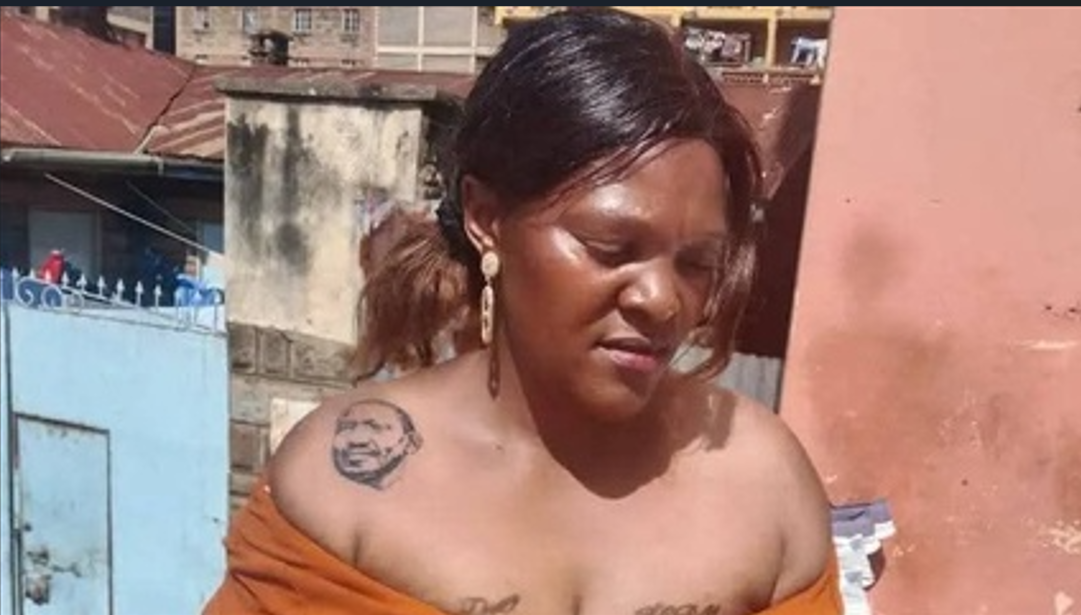
The tragic death of gospel artist Rachel Wandetto has become one of the most discussed stories in Kenya in recent days. What initially appeared to be a shocking case of political intolerance connected to her viral tattoo of President William Ruto is now evolving into something far more layered and uncomfortable.
As investigations continue, the story is slowly shifting away from politics alone and toward questions involving money, personal relationships, public perception, and the dangerous speed at which social media creates narratives before facts fully emerge.
And honestly, that may be the most revealing part of this entire case.
How Rachel Wandetto Became a National Conversation Overnight
Before the attack, Rachel Wandetto was already attracting attention online after publicly tattooing the face of William Ruto on her body alongside a phrase praising the president.
In Kenya’s current political climate, that was almost guaranteed to go viral.
Supporters praised her loyalty. Critics mocked the decision. Social media did what it always does: turned a personal choice into a national debate within hours.
But nobody expected the story to spiral into tragedy.
According to reports referenced in the original story, Rachel was attacked in Mwiki, Kasarani, by unknown men who allegedly assaulted her and set her on fire. She later died while receiving treatment at Kenyatta National Hospital after suffering severe burns.
Almost immediately, many Kenyans concluded that her attack was politically motivated.
And to be fair, it was not difficult to see why people made that connection.
The Political Intolerance Narrative Was Always Going to Explode Online
Kenya is currently living through an era where politics no longer stays in rallies or Parliament. Politics has entered TikTok lives, WhatsApp groups, family dinners, YouTube comment sections, and even tattoos apparently.
So when someone publicly associated with a political figure is attacked, people instinctively interpret the incident through a political lens.
Several leaders, including Kipchumba Murkomen, Moses Kuria, and Oscar Sudi, condemned the incident strongly. The emotional atmosphere online grew even larger after President Ruto himself publicly mourned Rachel Wandetto.
At that point, the public narrative had almost completely settled:
Rachel Wandetto was attacked because of her support for President Ruto.
Case closed.
Except… investigations rarely move at the speed of Twitter.
The Emerging Investigation Is Pointing Somewhere Else
Now the story appears to be taking a different direction.
According to details mentioned in the original account, investigators are reportedly exploring the possibility that the attack may have involved financial disagreements and personal conflicts rather than direct political targeting.
A suspect identified as Josiah Geru, reportedly Rachel’s taxi driver, has allegedly been arrested in connection with the case. Investigators believe the suspect may have assumed Rachel had recently received money from influential people due to her visibility and reported visits to places associated with political power.
One detail stands out more than anything else: Rachel reportedly told people before her death that the attackers accused her of “eating Ruto’s money alone.”
That sentence changes the emotional structure of the entire story.
Suddenly, the conversation moves away from ideology and enters a very human space — jealousy, assumptions, financial desperation, resentment, and perceived access to power.
And if investigators are correct, then this may not have been a political assassination at all. It may have been a deeply personal conflict wrapped inside political symbolism.
Social Media Turned a Complex Story Into a Simple One
One thing this case reveals is how badly people want simple explanations.
A tattoo. A president. An attack.
That combination created a perfect viral narrative.
But real life is usually messier than hashtags.
Sometimes political symbols become attached to personal disputes. Sometimes public attention distorts investigations before evidence is available. And sometimes online audiences unknowingly build entire emotional conclusions around incomplete information.
This is not to dismiss concerns about political intolerance in Kenya. Those concerns are real. But this case may also expose another problem: the speed at which emotionally satisfying narratives spread online.
The internet loves certainty.
Investigations do not.
The Dangerous Illusion of “Access to Power”
Another fascinating layer in this story is the perception of wealth and connections.
In Kenya, once someone is seen near politicians, government offices, or influential circles, many people immediately assume money is flowing behind the scenes.
It does not matter whether that assumption is true.
Visibility itself becomes currency.
Rachel Wandetto’s viral fame, political association, and public attention may have unintentionally created an image that she had access to financial benefits. If investigators are right, that perception alone may have contributed to the motives behind the attack.
And honestly, this is not unique to politics.
Kenyan social media has created an economy where appearing connected can sometimes become dangerous. People project wealth onto influencers, activists, musicians, and viral personalities even when reality may be completely different.
Sometimes fame creates opportunities.
Sometimes it creates targets.
Why the “Love Triangle” Angle Is Capturing Attention
The mention of a possible romantic conflict has added another layer of public fascination to the case.
Human beings are naturally drawn toward stories involving relationships, betrayal, jealousy, and emotional conflict. Add politics and viral fame into the mix and suddenly the story becomes irresistible to online audiences.
But this is also where caution matters.
Speculation spreads faster than verified facts, especially when emotions are high. Investigators are still piecing together events, and many details remain unclear.
That has not stopped social media detectives from acting like they graduated from the FBI after watching three crime documentaries on Netflix.
Still, the possibility of personal conflict changes how people interpret the case. It reminds us that public stories often hide deeply private tensions underneath.
What the Rachel Wandetto Story Says About Kenya Right Now
Beyond the headlines, this story reflects several realities about modern Kenya:
- Politics now shapes public identity in extreme ways
- Viral fame can quickly become dangerous
- Social media narratives often outrun investigations
- Public sympathy can become politicized within hours
- Perceived wealth creates real-world risks
Most importantly, the case shows how quickly people turn incomplete information into absolute truth.
And that should concern everyone.
The Rachel Wandetto case began as what many believed was a clear story about political intolerance. But as investigations continue, the situation appears far more complicated than the internet initially assumed.
What may ultimately emerge is not simply a political story, but a cautionary tale about fame, perception, money, emotional conflict, and the dangerous speed of modern public opinion.
And perhaps that is the uncomfortable truth hiding underneath the headlines:
Sometimes the loudest narrative is not the most accurate one.